
#1 Zendesk Alternative FOR MIDSIZED E-COMMERCE BRANDS
Take on more volume without adding agents or AI cost
About 70% of Dixa customers came from Zendesk. They moved for a simpler platform, lower AI cost per resolution, and a team that helps them ship the changes instead of pointing them at the docs.
Most teams migrate from Zendesk in 2-4 weeks.
Trusted exceptional brands across 42 countries





.svg)


Why brands switch from Zendesk to Dixa

Free up your reps
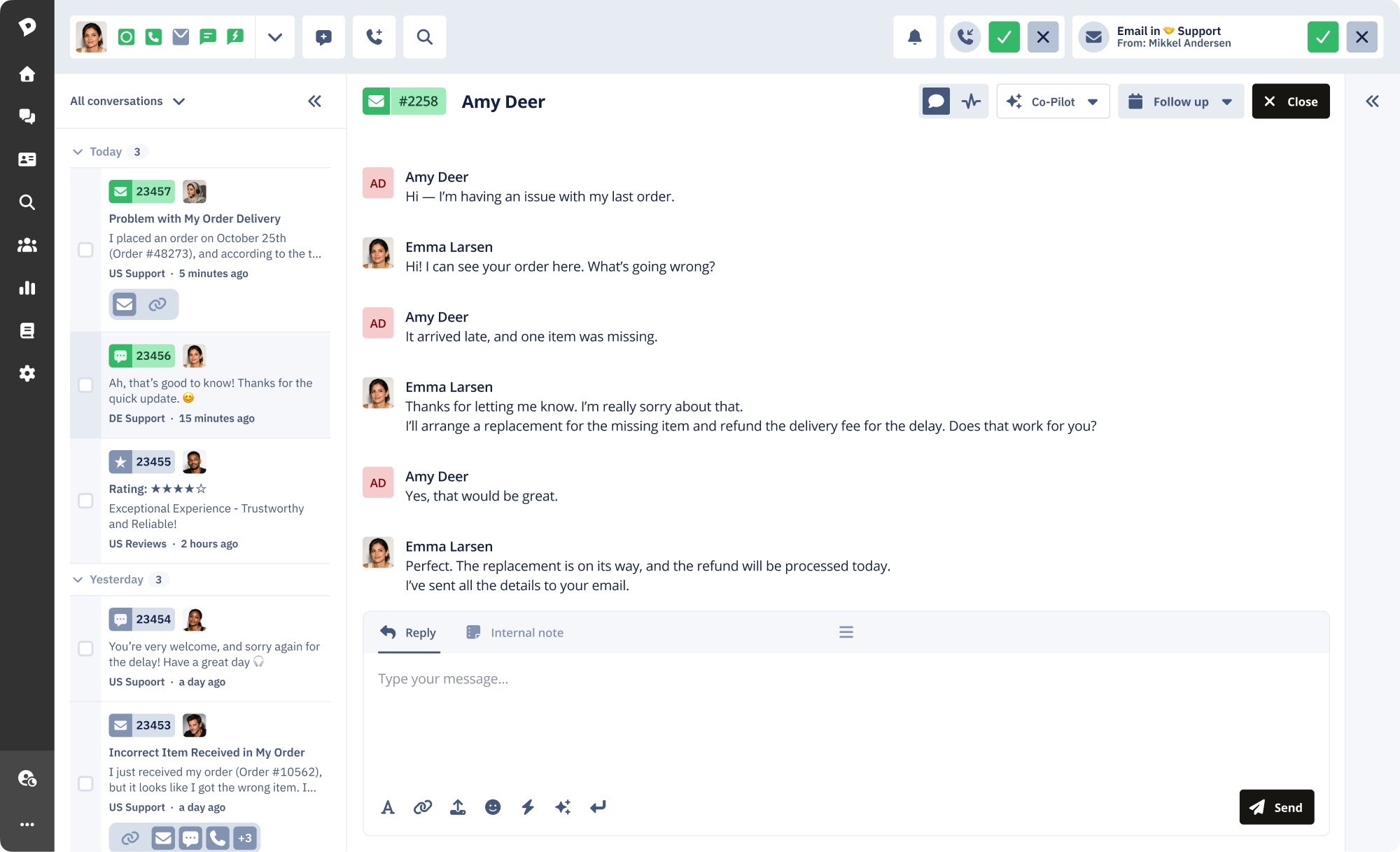
Dixa lets reps handle more conversations in less time. Reps spend their time replying, not searching. Every channel, customer history, and order data sit in one view, with AI suggestions ready when they need them.

Pay less per resolution
Dixa delivers superior AI out of the box at a third of Zendesk's cost. Agentic AI is standard in every plan, not a premium add-on. Our AI agent handles conversations at ~$0.70 per resolution versus Zendesk's ~$2.00. And that's before their add-on fee.

Work with a real partner
Every Dixa customer gets a dedicated customer success manager, hand-held onboarding, and strategic sparring as standard. Strategic partnership is part of the product, not an enterprise add-on.
Dixa vs Zendesk: How the platform compares
Feature
Platform architecture
Built for
Best for
AI agent cost
Seat pricing
Channels included
Contact center capabilities
Agent workspace
Multi-brand support
Intelligent routing
Workflow builder
Analytics
Customer success
Plans and onboarding
Implementation
Dixa
Customer service platform. Help desk and contact center fully integrated and included in all plans.
Mid-sized consumer brands where voice and AI are core to service.
Retail, ecommerce, and other B2C industries where customers call, and conversations span channels.
$0.40 per conversation, $0.66 average per resolution. No seat-based allowance, no cap.
Higher seat price, lower total cost. Contact center and full agentic AI included.
Voice, email, chat, WhatsApp, Instagram, Messenger, SMS. Native in every plan.
IVR, call recording, callback, and intelligent voice routing in every plan.
One screen. Every channel, customer history, order data, and AI suggestions in the conversation.
One workspace, multiple brands. Separate routing, knowledge, and CSAT per brand
Intelligent Routing (rule-based) on every plan. AI-based routing on Ultimate and above.
Visual, no-code drag-and-drop; CS team owns changes.
Real-time dashboards across every channel. Live queue, agent, and customer data.
A named CSM and direct line on every plan. Not a queue.
No self-serve plan. Every customer gets a CSM and hands-on onboarding.
Most teams live in 2-4 weeks with hands-on onboarding.
Zendesk
A help desk. With siloed capabilities bolted on - including voice and AI.
Smaller teams or companies where voice and AI are nice-to-haves.
SaaS and tech. Built for email and chat. Extended to other industries through add-ons and configuration.
Per-seat allowance (10–15/seat/month, capped at 10,000/year). $1.50 within, $2.00 above.
Lower seat price, higher total cost. Contact Center and Advanced AI Agents sold separately at $50 per seat each.
Email and forms in base plans. Voice, chat, and messaging require Suite.
A separate Contact Center add-on at $50/agent/month on top of Suite.
Support, Chat, Talk, and Guide as separate modules. Agents toggle tabs to find context.
Multi-brand requires separate instances or paid hierarchies.
Basic routing rules on lower tiers. AI-based routing requires Suite Professional plus the Copilot add-on.
Triggers and automations require admin or developer setup for non-trivial changes.
Reports lag by up to 24 hours. Advanced analytics requires Explore, a separate license.
A ticket queue, unless you've paid for enterprise support.
Self-serve SMB plan. CSM and hands-on onboarding on enterprise tiers only.
Implementation typically measured in months; consultants often required.


"Zendesk was siloed. Dixa gave us the one-screen wonder we needed"
Rapha wanted one global #OneRapha team. Zendesk siloed them. On Dixa, agents build relationships, not click between systems.
- Unified all channels into one agent workspace
- Eliminated tab-switching and lost context
- Agents now focus on conversations, not navigation
+14%
improvement in CSAT
+22%
increase in agent efficiency


"Email response went from 5 days to 50 minutes. We went from 16 to 6 people."
tink, Europe's leading smart home retailer, switched from Zendesk in 2024 to handle rising volume with a leaner team. The shifts in containment, seasonal hiring, and customer satisfaction speak for themselves.
- Unified workspace with Magento order data built in
- Automated routing based on order and shipping data
- AI resolves refunds, tracking questions, and FAQs across email and chat
63%
headcount reduction
70%
Live chat containment

Ready to leave the tabs behind?
See why 40+ brands switched from Zendesk to Dixa.
